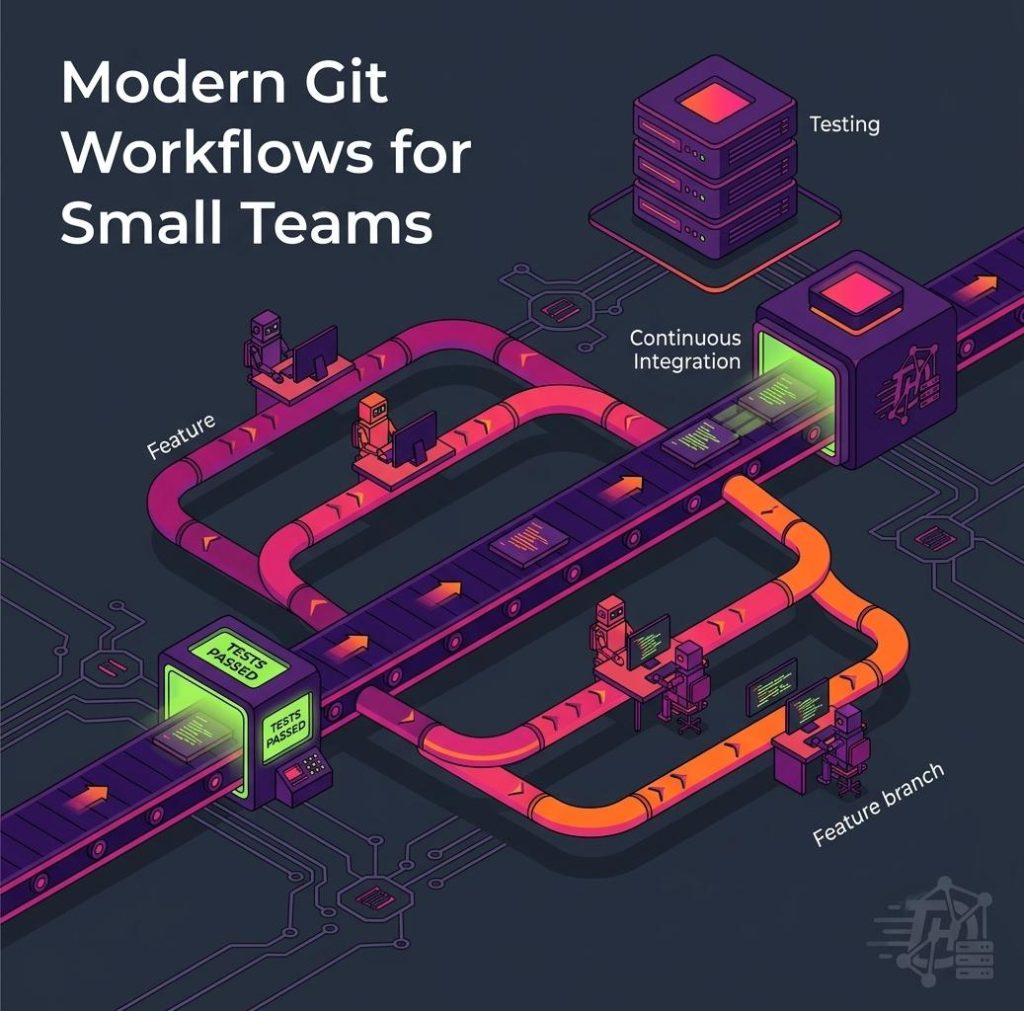
As you scale platforms like DevHubStack, establishing a lightweight repository architecture is foundational to building operational trust and engineering momentum. Every hour spent resolving painful merge conflicts or tracking down orphaned release branches is an hour stolen from core product development. To protect your shipping velocity, your version control strategies must be intentionally optimized for minimal friction and rapid delivery loops.
This technical guide breaks down the architectural shift toward lean code management, compares leading industry approaches using Git, and establishes a proven configuration optimized specifically for teams of two to ten developers.
The Structural Divide: Moving Beyond Legacy Git flow
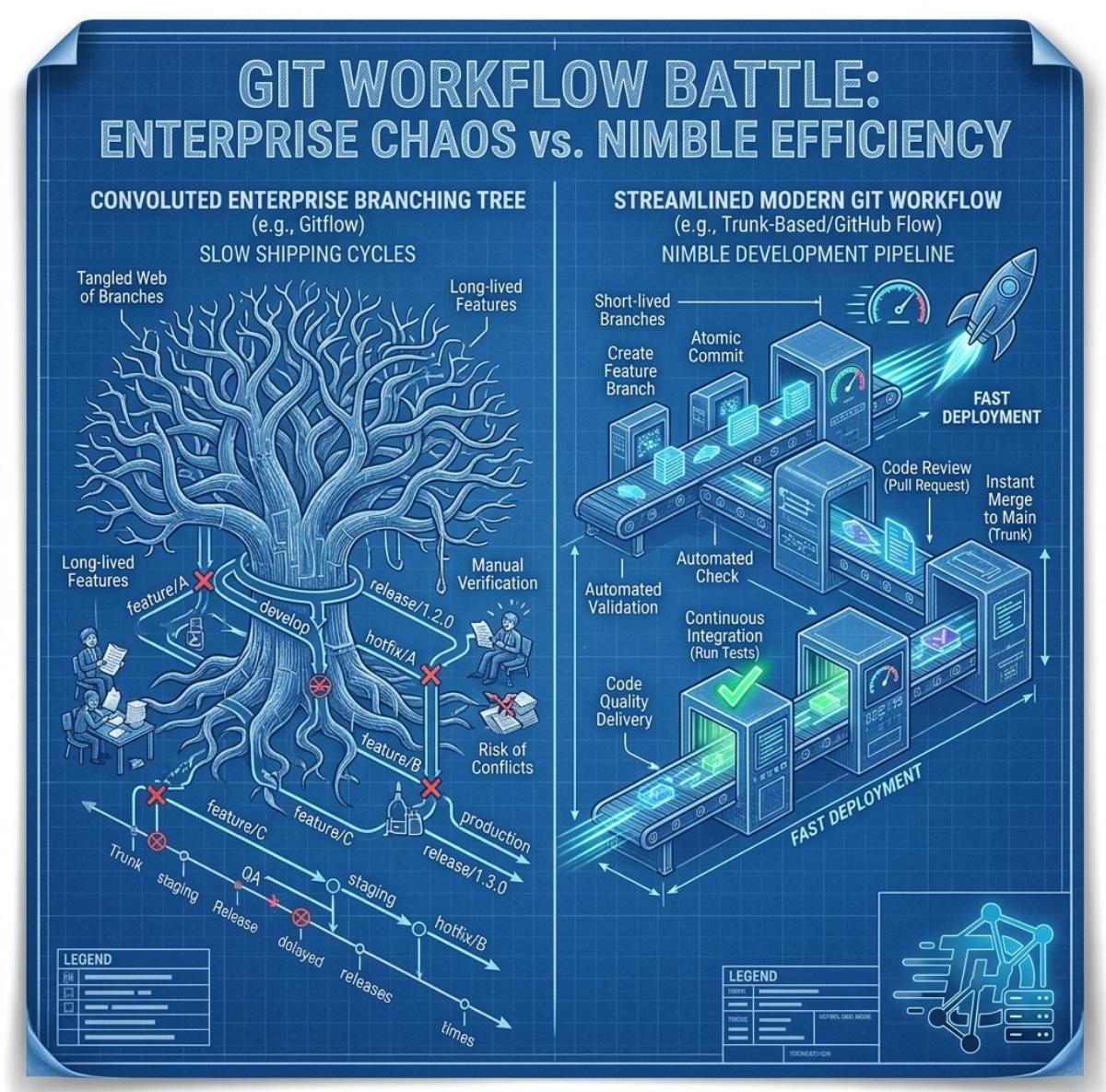
For years, the classic “Git flow” paradigm was the undisputed baseline model for source control. It segregates code bases into permanent master, develop, feature, release, and hotfix branches. While highly isolated, this multi-layered abstraction creates severe bottlenecks for compact dev squads.
Modern agile development demands a flat architecture. When multiple branches run parallel for weeks, the delta between your local workspace and production widens exponentially. This directly triggers complex, error-prone merge events. Lean operations require moving closer to a trunk-based execution framework where integrated automated testing mitigates code collision risks cleanly.
| Workflow Strategy | Branch Lifespan | Ideal Team Topology | Key Bottlenecks for Small Teams |
|---|---|---|---|
| Classic Git flow | Long-lived (Weeks/Months across environments) | Large enterprises with rigid release schedules | Extensive merge overhead, isolated staging states, and slow deployment cycles. |
| GitHub Flow | Short-lived (Hours/Days via Feature Branches) | Nimble SaaS companies and startup teams | Requires robust continuous integration pipelines to prevent main-branch regression. |
| Trunk-Based Development | Extremely short-lived (Merged directly multiple times daily) | High-maturity continuous deployment engineering teams | Requires advanced architectural safeguards like active feature flags. |
Evaluating the Friction: Branch Lifespans and Velocity
The core health metric of any repository strategy is the average lifespan of a feature branch. The longer a branch lives in isolation outside the primary pipeline, the more abstract it becomes. In small team dynamics, this manifests as hidden blockages where developers hesitate to pull down upstream changes due to fear of breaking local dependencies.
By transitioning development workflows to SaaS provider engines like GitHub or GitLab, small operations can lean on short-lived feature branches tied tightly to automated validation suites. Code goes from conception to review, validation, and main branch integration within a compressed 24-to-48-hour window.
Engineering Deep Insight: For squads under ten developers, a bloated branching strategy acts exactly like unoptimized application code. It increases execution latency and consumes finite human clock cycles. Eliminate environment branches (like dedicated staging or testing targets) and manage configurations strictly via runtime variables instead.
The Practical Roadmap to Implementing Lean Workflows
Ready to refactor your team’s code delivery loop? Follow this step-by-step framework to migrate away from branch inflation and establish a high-trust production ecosystem:
-
1Enforce Main Branch Protection RulesLock your primary production trunk entirely. Prevent any team member from pushing code changes directly to the main branch without passing through a standardized, verified pull request pipeline containing baseline linting rules.
-
2Incorporate Atomic Pull RequestsTrain your engineering team to keep pull requests hyper-focused. A single code submission should isolate one explicit feature enhancement, bug fix, or documentation adjustment. This makes code reviews exceptionally fast and drastically minimizes merge footprint conflicts.
-
3Automate Baseline CI Linting and TestingRemove human subjectivity from code formatting validations. Connect a modern automated execution engine that automatically tests syntax, formatting constraints, and basic unit test configurations the moment a feature branch opens an active merge request.
-
4Adopt a Delete-on-Merge Repository PolicyKeep your repository history completely clean. Enable the native repository setting to automatically delete feature branches instantly upon a successful merge action. This keeps the workspace free of dead references and avoids technical debt pileups.
Securing Engineering Momentum
Optimizing your team’s version control structure provides compound returns across your entire technical platform stack. By shifting away from long-lived, complex environment layers toward crisp, short-lived feature pipelines, you remove the invisible friction points that stall digital products. Focus on clean branch strategies, automate verification, and prioritize shipping over synchronization bookkeeping. For teams building toward full autonomy, pairing these workflows with a self-hosted development environment creates a powerful end-to-end ownership model.