
Next.js has cemented itself as the premier React framework for building high-performance web applications. However, once you have finished coding locally, you face a critical decision: how and where do you host it? The deployment landscape for Next.js is diverse, ranging from zero-config “golden paths” to complete infrastructure control on a raw virtual server.
Choosing the wrong platform can lead to architectural constraints, unexpected costs, or poor performance due to inadequate support for Next.js features like Server-Side Rendering (SSR) and Incremental Static Regeneration (ISR). This guide breaks down the four most viable deployment strategies for Next.js applications in 2024.

The “Golden Path”: Managed Serverless Platforms
Managed platforms offer a “git-push to deploy” experience. They abstract away server management, automatically configuring CI/CD pipelines, Global CDNs, and serverless functions to handle dynamic Next.js features.
1. Vercel (The Creators)
As the creators and maintainers of Next.js, Vercel offers the “golden path” experience. Vercel is designed to support the full spectrum of Next.js capabilities natively, often deploying new features on day zero.
- Native Feature Support: Perfect support for ISR, SSR, Middleware, and Next/Image optimization.
- DX: Unmatched Developer Experience with preview deployments and instant rollbacks.
- Edge Network: A sophisticated global edge network optimized for framework performance.
2. Cloudflare Pages (The Edge Disruptor)
Historically known for CDN and security, Cloudflare Pages has become a massive disruptor in managed hosting. It leverages Cloudflare’s massive global network, running SSR through the super-fast Cloudflare Workers runtime.
- Edge Computing: Dynamic routes run on Cloudflare Workers, offering incredibly low latency globally.
- Pricing: Extremely generous free tier and cost-effective paid plans based on request count rather than compute time.
- Integration: Tight integration with the wider Cloudflare ecosystem (R2, D1, KV).
3. Netlify (The Composable Leader)
Netlify is a pioneer of the Jamstack and composable web. It offers a robust managed experience for Next.js, utilizing their “Next.js Runtime” to adapt Next.js features to Netlify’s serverless infrastructure.
- Ecosystem: Strong support for the “composable web,” making it easy to integrate various APIs and services.
- Features: Excellent support for ISR (via On-Demand Builders) and Edge Functions.
- Management: Great UI for managing large, complex web projects across teams.
Key takeaway on managed platforms: Managed platforms are incredible for velocity, scalability, and developer experience. However, you pay a premium for compute and bandwidth, and you accept vendor lock-in regarding the specific serverless environment your code runs in.
The Road Less Traveled: Self-Hosting on a VPS
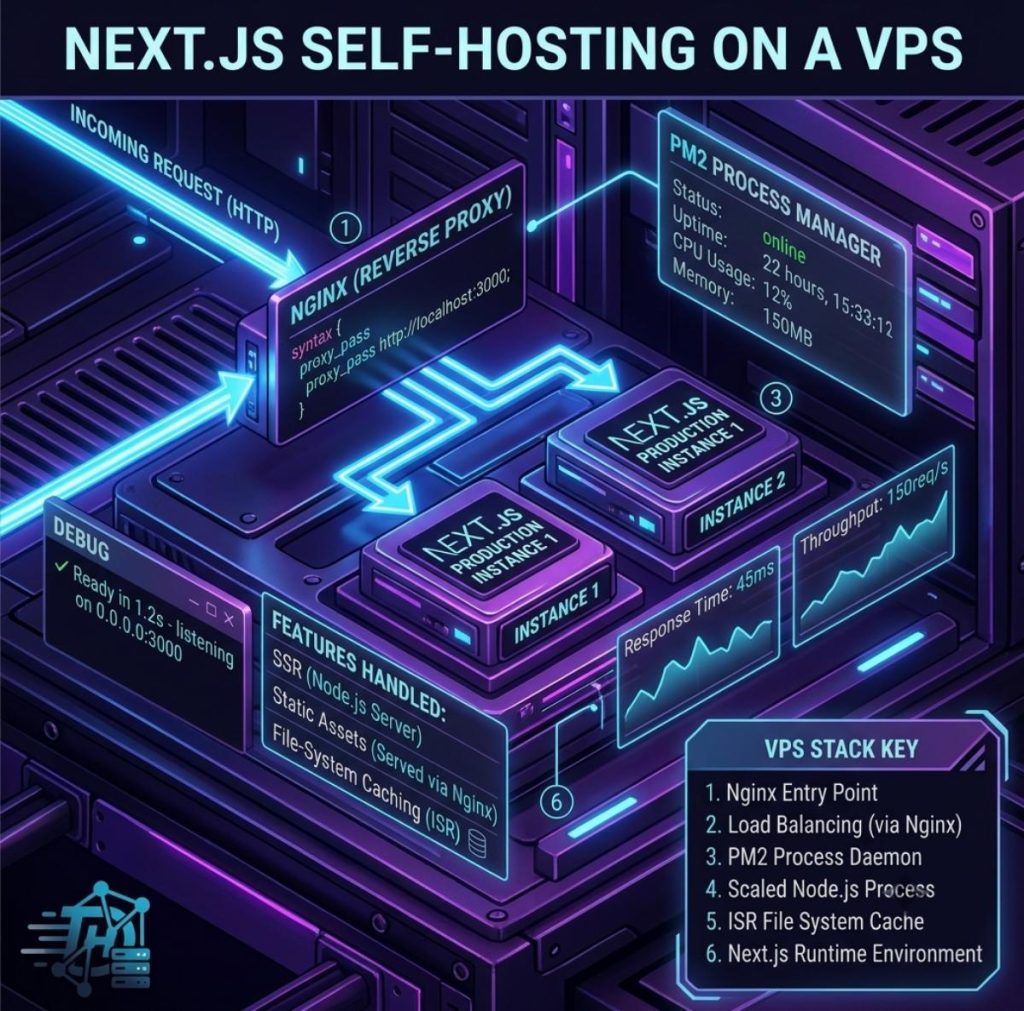
For complete control, you can bypass managed platforms and host Next.js yourself on a Virtual Private Server (VPS) from providers like DigitalOcean, Linode, or Hetzner. This involves running the Next.js app as a Node.js server, usually managed by PM2 and proxied behind Nginx.
- Full Control: Complete access to the OS, Node.js configuration, and reverse proxy setting.
- Predictable Pricing: You pay a fixed monthly cost for the raw resources (CPU, RAM, Bandwidth).
- No Vendor Lock-in: You can move your Dockerized Next.js app to any VPS provider.
Data Comparison: Feature Support & Workflow
The following matrix compares how vital Next.js features and workflows are handled across the different deployment strategies.
| Feature | Vercel | Cloudflare Pages | Netlify | VPS (Self-Host) |
|---|---|---|---|---|
| Dynamic Routing (SSR) | Native Serverless | Native Workers (Edge) | Native Serverless | Node.js Process |
| ISR Support | Native | Beta/Workarounds | Native (via Builders) | Manual/File System |
| Image Optimization | Native (Vercel Image) | Cloudflare Images | Netlify Image CDN | Next.js Default (Slow) |
| Middleware | Edge Functions | Cloudflare Workers | Edge Functions | Node.js Middleware |
| CI/CD Workflow | Zero-Config Git | Zero-Config Git | Zero-Config Git | Manual (GH Actions/Docker) |
How to Choose Your Next.js Deployment Path
There is no single “best” path. The correct choice depends heavily on your team’s expertise, budget, and the architectural requirements of the application.
-
1Choose Vercel for DX & VelocityIf your priority is time-to-market, unmatched developer experience, and guarantee that new Next.js features will just work, Vercel is the default choice. It is ideal for startups and agency projects.
-
2Choose Cloudflare for Cost & Edge PerformanceIf you expect high traffic, need global low-latency SSR, and want a predictable pricing model that scales, Cloudflare Pages is superior. Ideal for global applications and performance-critical sites.
-
3Choose VPS for Control & Predictable BudgetIf you require customized OS configurations, need to run supporting Node.js cron jobs, are on a strict fixed budget, or are uncomfortable with vendor-specific serverless runtimes, self-hosting on a VPS (ideally using Docker) is the correct path.
Regardless of the path you choose, Next.js remains highly portable. By structuring your application efficiently and avoiding excessive vendor-specific APIs in your core logic, you ensure that you can migrate between these platforms as your needs evolve.